The War
Journey to the End of the NightThe War is the narrator’s experience of war as both collective violence and a continuing disturbance of ordinary life. Its defining movement is from bewildered exposure to explicit rejection: the narrator encounters wartime authority and patriotic rhetoric, becomes unable to treat danger as distant, and carries the experience into later memories, encounters, and sleepless nights.
Approach and Exposure
The war first approaches without the narrator recognizing its nearness. A discussion with Arthur ends in reconciliation even as the narrator senses that something is wrong with his own wits; the immediate irritation of being treated as ungenerous over a tip sits beside the larger crisis he cannot yet understand. The narrator’s metaphor of people below deck, laboring at the oars while their masters enjoy the open air, gives this emerging conflict a class dimension: those who do the work are also the ones summoned to fight, while the rewards and rhetoric belong to others.
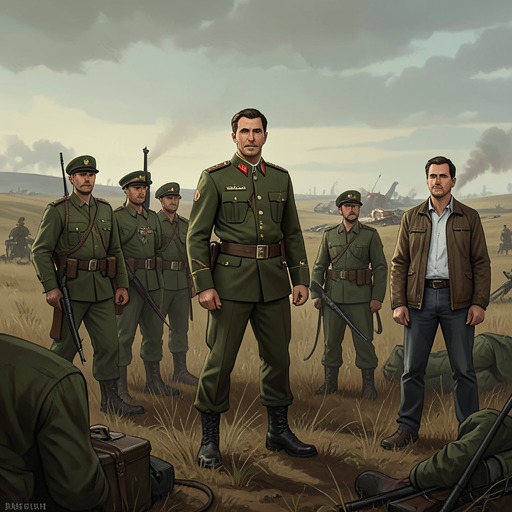
Exposure to the front changes the scale of the narrator’s fear. He sees a colonel who appears unable to conceive of his own death and imagines countless similarly fearless men on both sides. Their apparent bravery makes the war seem capable of continuing indefinitely. The narrator describes his own experience as a first encounter with horror: what had been unimaginable from civilian life now appears as a mass movement toward collective killing. His shift is not toward acceptance or heroic resolve, but toward recognition of the danger and madness concealed by the language of military purpose.
Patriotism and Resistance
Wartime authority turns patriotic language into a demand for submission. In an institutional argument about what best compels the elite to act altruistically, a professor identifies patriotism and glory as the decisive ideals, presenting self-preservation as something soldiers supposedly cast off at their first exposure to fire. The narrator’s later account of fear contradicts this doctrine. In the hospital, his comrades are watched and assessed as men who may be returned to the front; paperwork, identification tags, and official precautions make their future military use legible even when staff avoid speaking directly about death.
The narrator refuses the expectation that fear should be overcome by patriotic conviction. When he tells Lola that he does not want cremation because he wants even the remote possibility of returning to life, she calls him a coward. He accepts the description but makes his refusal explicit: he rejects the war and its fighters, rather than merely grieving over it or resigning himself to it. His stated reason is direct self-preservation: he does not want to die. The exchange makes his fear a dissenting position against the public majority, not a failure he tries to disguise as courage.
Wounds, Institutions, and Everyday Life
The narrator’s fear has consequences beyond the front. After becoming delirious, he is treated as a potentially troublesome or impaired soldier. Some people call him an anarchist and want him shot; others consider him sincerely insane and would confine him for the duration of the war. The authorities instead place him under observation. He and other wounded men are lodged in a converted secondary school at Issy-les-Moulineaux, where staff monitor them and attempt, by persuasion or force, to obtain confessions of their patriotic fitness. The episode turns the question of sanity into a contest over who has the authority to define it: the people who continue the war claim normality, while the man whose fear has made him unable to participate is scrutinized.
The war’s reach becomes visible in ordinary settings and later work. In wartime Paris, a shooting-gallery wedding scene unsettles the narrator; as he walks with Lola along the Avenue Royale toward Saint-Cloud, he remains fixated on the painted targets and says that he too is being shot at. At Duval’s, the diners seem to him like people awaiting gunfire. Later, while examining a young woman in a medical emergency, he compares the blood he sees to the colonel’s fatal wound from the war. The recollection does not change the immediate task, but it reveals how a wartime image has entered the narrator’s perception of civilian suffering.
Recurrence and Aftermath
The narrator’s departure from the war does not end its presence in his life. In New York, alone in a small hotel room, the passing elevated train unsettles him: its repeated movement through the city becomes an image of a powerful, jolting mechanism. The scene is not identified as a direct recollection of battle, but it belongs to the continuing pattern of fear and estrangement through which the narrator experiences his surroundings.
Later, seeing Robinson again coincides with a return of unease and worsening sleep. The narrator connects the encounter to the revival of a bad dream from which he had never fully escaped, and says that he seemed to be falling sick again. In a subsequent period of sleeplessness, he imagines dramatic consequences of Grandma Henrouille’s fall into the mummy crypt; fear rises physically and keeps him pacing through darkness until dawn. He describes himself as having lost the trust needed to sleep among other people. These later episodes do not simply retell the war: they show the narrator’s present repeatedly disturbed by danger, memory, and anticipation.
The War therefore functions in the narrative as more than a bounded military episode. It supplies the narrator’s clearest confrontation with organized violence, discredits the ideals used to justify it, and leaves him with a persistent vulnerability to fear. Its later echoes connect public catastrophe to the private body and to ostensibly ordinary life, without offering a clean passage from wartime experience to safety.